
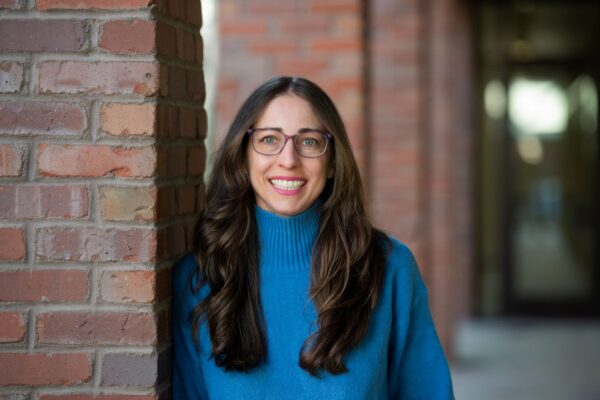

Name: Kaitlyn Denzler
Pronouns: She, her, hers
Position: Deputy executive director
Kaitlyn Denzler grew up in Las Vegas – sort of. Her family moved around a lot. At one point or another during her childhood, Kaitlyn also called South Dakota, Virginia, Alabama, and England home.
“That’s just life when you’re a so-called Air Force brat,” she said.
So it should be no surprise that, because of her upbringing, Kaitlyn caught the “travel bug.” That took her to Madagascar as a Peace Corps volunteer and then to Washington, D.C., for graduate school and work.
But Kaitlyn wasn’t ready to settle down just yet. As a foreign service officer for the United States Agency for International Development (USAID), she lived and worked in Ukraine, Bangladesh, and South Africa.
These days, however, it’s a different story.
“I could not be more excited to work for the ACLU and to finally put down some roots!”
When did you first hear about the ACLU and why is the work appealing to you?
The ACLU has been on my radar since high school and was always a dream organization for me. I strongly believe in the ACLU’s values and priorities to build a more just and equitable future where everyone — no matter their race, ethnicity, citizenship status, socio-economic status, sex, gender identity, sexual orientation, disability, and so on — can live freely without fear, discrimination, or persecution. It’s no secret that we have not yet lived up to our democratic ideals. To me, organizations like the ACLU, along with its members and partners, play a vital role not only in getting us closer to the promise of the Constitution but also in expanding its guarantees.
On a more personal note, prior to joining the ACLU I was a USAID foreign service officer working in the democracy, human rights, and governance sector. I led projects to strengthen labor rights, support LGBTQ+ and Indigenous communities, and defend electoral integrity, media freedom, and civic space.
What we are witnessing and experiencing here at home — currently at a more rapid and alarming pace and scale — are some of the same challenges I partnered with civil society actors abroad to address and prevent on behalf of the U.S. government. To name just a few: increasing scapegoating and dehumanization of marginalized communities, deepening political polarization, and the erosion of institutional checks and balances. Having worked on democracy and governance abroad, it’s deeply troubling to see tactics here that mirror the authoritarian playbook. This erosion isn’t new, but it’s so important that we actively defend the communities, rights, and institutions under attack.
To meet this moment, I am absolutely honored to join others across North Dakota who are working tirelessly to protect everyone’s civil liberties and defend against efforts to further erode democratic principles.
Which of the ACLU’s issue areas are you particularly passionate about and why?
I began my career in human rights advocacy focused on sexual and reproductive rights. I remain deeply passionate about reproductive freedom, but after spending years working on several other human rights challenges, I’m going to cheat a bit on this question and say I’m passionate about all of the ACLU’s issue areas.
In brief, it’s hard for me to pick just a few issues, and here’s why. Our work in North Dakota covers immigrants’ rights, LGBTQ+ and Two Spirit rights, Indigenous justice, freedom of speech, voting rights, reproductive freedom, housing justice, and criminal legal system reform.
I believe the threats facing these issues and the communities most impacted by them are deeply interconnected. Whether it’s restricting bodily autonomy, suppressing free speech, or limiting participation in our democracy, these efforts share the same throughline: limiting people’s freedom, voice, and ability to shape their own lives.
What is your favorite way to get involved in your community?
I like to find local organizations or coalitions that are deeply connected to the community and look for ways to support them. That looks different depending on where I am, but it has often meant opening my home as a place to gather, helping identify safe spaces to organize, and giving my time and energy toward a shared goal I care deeply about.
Do you have any advice for someone who might be interested in getting more politically involved in their community?
Yes, absolutely. As they say, “all politics is local,” so a good starting point is to stay informed through trusted local news outlets and community forums.
Identify one to three issues you care about (so you can stay engaged and don’t burn out), find groups that care about those same issues, and start connecting with other people. Track what local elected and unelected officials are doing on those issues, show up to committee meetings when you can, ask questions, and stay engaged. And, of course, don’t forget to vote in local elections.
If you don’t have like-minded groups in your community, start one. It doesn’t have to be a big undertaking; just keep it casual and create space for people to be in community and take collective action. The ACLU and other partner organizations have many great resources online to help facilitate conversations and action.
Which of the Constitution’s amendments are most important to you and why?
That’s a difficult question! I think the First, Fourth, Fifth, and 14th Amendments are foundational bulwarks against government overreach and tyrannical tendencies. However, the 13th, 15th, 19th, and 24th Amendments illustrate how we can, and should, continue expanding the Constitution’s guarantees to create a more perfect union for everyone. Together, these amendments reflect both our core freedoms and our ongoing responsibility to ensure those freedoms are truly accessible to all.