ACLU and ACLU of North Dakota File Brief in Support of Right to Protest on Public Roads
July 20, 2026 11:57 am
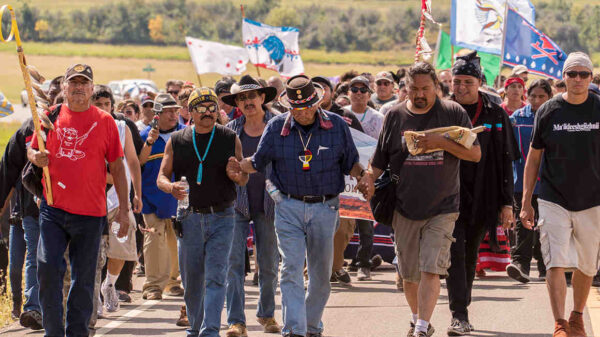
Courts across the country have long recognized that roads are quintessential traditional public forums and open for public assembly, debate and the communication of ideas.
That’s why the American Civil Liberties Union and the ACLU of North Dakota filed an amicus brief today with the United States Court of Appeals for the Eighth Circuit in Thunderhawk v. Kirchmeier, a case that challenges the government’s decision to close a public road during a Standing Rock protest, preventing people from assembling to express their opposition to the Dakota Access Pipeline.
In the brief, the ACLU argues that roads of every kind — including rural roads, multi-lane roads and high-speed roads — have served as sites of protest throughout United States history, from the civil rights marches and anti-war demonstrations of the 1960s and ’70s to more recent protests, including marches in opposition to abortion, in support of rural healthcare and against police brutality. Courts across the country have long recognized that roads are quintessential traditional public forums and open for public assembly, debate, and the communication of ideas.
“The government’s argument disregards our history of protest in the United States and misinterprets our fundamental First Amendment rights. Our right to assemble and protest in the streets should never depend on the type of roadway chosen,” said Andrew Malone, senior staff attorney for the ACLU of North Dakota. “The Supreme Court has repeatedly affirmed that protesting in public streets is a time-honored American right. It is long overdue for police officers, prosecutors and government officials to uphold this constitutional standard.”
For nearly eight years and through multiple rounds of dismissals and appeals, the government has argued that some streets, including rural roads, don’t belong to the community and that the road at issue in this case doesn’t deserve the same protection afforded to other public spaces. But, the ACLU argues in the brief, as one of the few communal spaces in rural areas, these roads are uniquely positioned to offer rural communities – and those wishing to address them – a public space in which to associate, communicate thoughts and discuss public issues.
“Protesting on public roads is as American as apple pie, and that doesn’t change whether the road is a rural highway in North Dakota or 42nd Street in New York City,” said Vera Eidelman, senior staff attorney with the ACLU’s Speech, Privacy and Technology Project. “People can turn the page in a magazine or change the channel on TV, but streets remain one of the few places where we have to confront ideas we might otherwise tune out – and that’s why our rights to protest on streets, sidewalks and in public parks are so important.”
A copy of the amicus brief is below.
---
About the ACLU of North Dakota
The American Civil Liberties Union of North Dakota is a chapter and program of the American Civil Liberties Union Foundation, a non-partisan, nonprofit organization dedicated to the preservation and enhancement of civil liberties and civil rights.
The ACLU believes freedoms of press, speech, assembly, and religion, and the rights to due process, equal protection and privacy, are fundamental to a free people. In addition, the ACLU seeks to advance constitutional protections for groups traditionally denied their rights, including people of color, women and LGBTQ+ and Two Spirit communities. The ACLU of North Dakota carries out its work through selective litigation, lobbying at the state and local level and through public education and awareness of what the Bill of Rights means for the people of North Dakota.
Documents
Related Issues
Stay Informed
Sign up to be the first to hear about how to take action.
By completing this form, I agree to receive occasional emails per the terms of the ACLU’s privacy statement.
By completing this form, I agree to receive occasional emails per the terms of the ACLU’s privacy statement.